
Iowa State House, Stephen Matthew Milligan, via Wikimedia Commons.

[Update, 2022:  For a more academic view of this issue, see William S. Dodge, Substituted Service and the Hague Service Convention, 63 Wm. & Mary L. Rev. 1485 (2022).]

Two weeks ago, I posted that you can’t simply serve a U.S. subsidiary of a foreign company & get the parent on the hook in a lawsuit.  For such an idea to work, your state’s public policy has to disregard the corporate veil.  Only one state has done so– and under very limited circumstances.  [That was Illinois, where they did it by statute– that I know of– and where the idea only pertains to Illinois subsidiaries.  That’s how we got Schlunk, the seminal case in Hague Service Convention jurisprudence.  No other state does it, that I know of.]

Another misconception seems to pop up from time to time: the thought that you can serve a foreign* corporation by delivery to the Secretary of State wherever the case is being heard because the Secretary is a statutory agent.  Sorry, but it just ain’t so.  When you do serve via the SoS, ask yourself, “what do they do with it?”

Continue Reading You Can’t Simply Serve the Secretary of State

I say all the time that we aren’t building rockets here.  But we are building a ship, and a leaky ship means that your people could not possibly reach North America from Europe.  Do it the right way, and you’re the FIRST EUROPEANS TO REACH NORTH AMERICA.  That’s right, I said it.  Scandinavians got here first.  Er, well, we didn’t get here first.  But we beat Columbus to the punch by about five hundred years.

Aaaaaanyhow… I often joke about those “evil Swedes who kept my Norwegian ancestors under their thumb for centuries” but the truth is, Scandinavia is made up of several (three or four, depending on who you talk to) wonderful and kindred cultures, and I look to Swedes as family.  We all answer to the Viking Horn and we all know intuitively that Valhalla awaits us in the afterlife.  And deep down, we all reeeeally want to drive a Volvo.

I digress.

Serving process in Sweden is subject to the strictures of the Hague Service Convention.  This holds true regardless of which U.S. or Canadian venue is hearing the matter.

You’ve got three ways to go:

  1. Tap us on the shoulder for bespoke attention—and probably some amusing commentary to boot (see the upper right if you’re on a desktop, or way down below if you’re on a phone/tablet),
  2. Cruise over to the Hague Envoy platform at USM94.com to automate the completion of your forms in perhaps twenty minutes or so, or
  3. If you’re feeling froggy & would like to handle the whole thing yourself, keep reading.  This lays out the framework you’ll need.

Some background is in order, if you’re so inclined, before we cut to the chase.

Here’s how it’s done in Sweden:

Article 5 Service

  • Translate the documents. Sweden’s declaration to Article 5(3) requires documents to be submitted in Swedish– or in Norwegian or Danish (a big cost saver if you have defendants elsewhere in Scandinavia).
  • Fill out a USM-94. Be very careful about ensuring that it is complete and concise, and make sure that it is signed by a court official or an attorney.  If it is not, make sure that the person signing is commissioned by the court.
  • Send to the appropriate Central Authority, in this case the Länsstyrelsen i Stockholms län.  [There will be a quiz later.]
  • Sit tight. It may take a while—likely several months from submission to return of proof.  [2025 update: Article 5 serves in Sweden are now taking over a year.  That is not a typo.]

Article 10 alternative methods

  • Mail service is available, but it’s a bad idea anyway. If you do select this route, pay particular attention to the venue court’s rules about how mail service is initiated—in federal cases, adhere strictly to FRCP 4(f)(2)(C)(ii).
  • Sweden also allows direct access to “judicial officers or other competent persons” under Article 10(b), but those competent persons must be specifically authorized by the Central Authority.  (Hint: we have an authorized team– and they can do it without translation if your defendant is demonstrably competent in English.  That’s a good thing, given that Swedish is quite an expensive language to translate into.)

Seriously—that’s all there is to it in Sweden.  Sweden’s declarations and Central Authority information can be found here.

And remember… if you’re defense counsel, always question the validity of service effected on your overseas client, because the plaintiff may not have done it correctly.  That actually happened once, with a defendant in Norway, and her lawyers were smart enough to fight the issue.  The Washington Court of Appeals erroneously thought going outside the Central Authority was okay, but their Supreme Court saw the matter differently.


I love ABBA, And I've loved them since the 1970s. Don't you dare judge me.
I love ABBA, And I’ve loved them since the 1970s. Don’t you dare judge me.

For the record (pun intended), my favorite Swedish export is not the Volvo.  It’s not Saab, it’s not IKEA (although– go there, go there again, and go there repeatedly), and I’ve never even been inside H&M.  It’s the fabulous pop sensation that forms the soundtrack of my childhood.  No kidding.  –>

Apollo 15 Endeavour splashes down, August 7, 1971. NASA photo.
Apollo 15 Endeavour splashes down, August 7, 1971.  Get it?  Splashes down?  NASA photo.

This space hasn’t offered much about the biggest news in transnational litigation in years– a test of the validity of service by mail under Article 10(a) of the Hague Service Convention.  Frankly, the outcome doesn’t much matter to me, because in most circumstances– as I’ve said repeatedly– mail service as a primary means is a bad idea.  But it’s a bad idea from a factual perspective, rather than a legal one.

As to its basis in law, I agree wholeheartedly with the plaintiff in Water Splash, Inc. v. Menon, which was heard live and in person before the Nine Eight Wise Souls this week.  For crying out loud, some drafting errors are not fatal to the broader intent of the drafters– the Chief Justice said as much in King v. Burwell— if this even was a drafting error.  It’s valid, and everybody else in the world thinks so.

Factually, mail is awfully questionable, so I can’t be phased that its use under the HSC will almost certainly be validated.  A huge chunk of my practice comes from the 2d and 9th Circuits, where mail service has been valid all along, so losing an automatic bar in the 5th and 8th is relatively inconsequential.  What bugs me most is that I wanted to argue it, and never got a shot.

For thorough coverage of the case, refer to the ongoing Water Splash Resource Page at Ted Folkman’s outstanding Letters Blogatory.  And for a rundown on Wednesday’s oral arguments, see SCOTUSblog here.

I agree with Ted’s prediction that the Court will resolve the circuit split handily– he thinks perhaps unanimously, but I can’t give such good odds to logic in today’s world.  I hope he’s right.

Now I think I might go for a swim.

Wright FlyerFor the entire life of my firm, I’ve had a recurring theme in just about every blog I’ve posted:  yes, counsel, you do have to translate that thing.  Translation is almost always unavoidable if you want a realistic chance of collecting a judgment.  But last summer, I offered some tips to limit the cost of translation of documents that have to be served abroad.  The first two bits of advice: keep brevity in mind (easy as pie for lawyers!), and avoid exhibits wherever possible.*  Within the past month, these ideas have become particularly important to two separate clients in the very same practice area:  patent infringement.  Problem is, those clients hadn’t heard the advice prior to filing their claims, and it has cost them dearly.  Six figures dearly.

Patent infringement suits frequently involve foreign defendants.  Routinely.  In any sort of lawsuit, when just one defendant has to be served in a non-English-speaking country, especially one that is a member of the Hague Service Convention, the documents to be served must be translated.  Every word, every page, including exhibits, which are naturally part of the complaint they’re attached to.  The defendant may be quite competent in English—he may even be a U.S. citizen or “it” (an entity) may be presumed competent simply because it does business in the United States.**

None of that matters, because it’s not about the defendant.  It’s about the foreign officials handling the documents… and those officials don’t sprechen-sie Englisch or parlez-vous anglais.

When even a seemingly short patent is included in the exhibits, the cost to translate goes up considerably.  When two or three (or ten!) patents are involved, the cost can be astronomical.  So how do you get around the cost?  Well, unless local rules force you to attach them as exhibits, just reference the patents and quote the relevant portions.  They’re a matter of public record, so if your defendant wants to know what a particular paragraph says in a specific patent, it isn’t that hard to look up.

Take the Wright Brothers’ patent for the aeroplane (yes, it’s spelled that way in the filing).  It’s just shy of seven thousand words.  Translate that thing into Chinese, and you’re looking at a $2,000 project, with formatting and editing and proofreading.  The Wright patent is a mere seven pages, omitting drawings.  Today, hundred-page patents are routine.  Extrapolate that into dollars and you see the horror of serving in three different countries, all of whom require a different language other than English.

But if the complaint just says “reference U.S. Patent No. 821,393, page three, line ten”, and includes the relevant text and figures (but omits the rest), a whole bunch of resources are saved.

Unfortunately, if you’ve already filed the complaint with the full text, it’s probably too late.  But a bit of forethought prior to drafting can save literally tens of thousands of dollars in costs to serve.

Tens. Of. Thousands.

Who doesn’t want to do that?


* My understanding is that it’s not possible in D. Del., as local rules require that patents be attached.  If anybody knows a way around that rule, give a shout.

** Ahem, “it” being an entity.  Yes, if an entity does business in the United States, it is presumed to be competent in English.  But that isn’t the end of the analysis.  When serving such defendants, their home countries’ declarations to the Hague Service Convention control language issues—not the presumptions of U.S. law.

*Not the version at issue here. This is a 2005 Q7. Ygrek, via Wikimedia Commons.
*Not one of the vehicles at issue here. This is a 2005 Audi Q7.  Ygrek, via Wikimedia Commons.

Much has been made lately of the Volkswagen “defeat device” scandal, and it seems to now encompass Audi as well.  For the uninitiated, the un-refuted story is that VW programmed its diesel vehicles to perform differently under EPA testing conditions that they would in the real world, on actual roads while driven by actual people.  Better EPA rating, higher sales, but no benefit to the environment.  A whole bunch of people thought they were buying a greener car, but they were being duped.  When the story broke, all hell broke loose with it, and the Volkswagen name was severely tarnished, maybe never to recover its former reputation.  Lawsuits piled up, and the company took great pains to diffuse the damage.

Last week, German investigators went after the company’s Audi subsidiary, and searched the sub’s Ingolstadt headquarters for evidence that Audi, too, was part of the scheme to defraud the EPA.  To be sure, Audi suits are sure to come as well, even as claims against Volkswagen mount.  Very likely, the parent is likely to be named in suits against the subsidiary, and it thus becomes crucial for plaintiffs to serve process in a meticulous manner.

Regardless of which company is on the hook, the Hague Service Convention fully controls how notice is officially given to the defendants in Germany.  There is but one proper avenue to service in Germany (described here), and FedEx ain’t it, so don’t even try it.

Know, too, that you cannot simply serve Audi and assume that Volkswagen will show up to defend.  You’ll need two separate Hague requests sent to two separate Central Authorities– one in Lower Saxony and the other in Bavaria (don’t forget to translate!).  And you’ll need to wait a couple of months until proof comes back.  The Germans are pretty quick compared to the rest of the world, but measure the response time with a calendar– not a clock.

[Author’s Note: yes, things are still functioning in Israel despite the war in Gaza, with the obvious exception of service within Gaza itself.  For defendants not located in the Palestinian territories, service is essentially business as usual.]

Serving process in Israel is subject to the strictures of the Hague Service Convention, regardless of which U.S. or Canadian venue is hearing the matter.

You’ve got three ways to go:

  1. Tap us on the shoulder for bespoke attention—and probably some amusing commentary to boot (see the upper right if you’re on a desktop, or way down below if you’re on a phone/tablet),
  2. Cruise over to the Hague Envoy platform at USM94.com to automate the completion of your forms in perhaps twenty minutes or so, or
  3. If you’re feeling froggy & would like to handle the whole thing yourself, keep reading.  This lays out the framework you’ll need.

Some background is in order, if you’re so inclined, before we cut to the chase.

Here’s how it’s done in Israel, specifically:

Article 5 Service

  • Translate the documents. Israel’s declaration to Article 5(3) allows the Central Authority to accept documents in English, but it may be necessary to translate them anyway.  If the defendant doesn’t speak English, the documents should be translated into either Hebrew or Arabic, depending on his or her native tongue.*  At least under Hague procedures, Israel is adamant about ensuring due process to the Arab population in its jurisdiction.  (See infra for insight regarding the Palestinian Authority.)
  • Fill out a USM-94. Be very careful about ensuring that it is complete and concise, and make sure that it is signed by a court official or an attorney.  If it is not, make sure that the person signing is commissioned by the court.
  • Send to the Central Authority, who will then instruct a Magistrate’s Clerk to serve.
  • Sit tight. It may take a while—perhaps 6 months from submission to return of proof, depending on the defendant’s locality.

Article 10 alternative methods

  • Mail service is available, but it’s a bad idea anyway. If you do select this route, pay particular attention to the venue court’s rules about how mail service is initiated—in federal cases, adhere strictly to FRCP 4(f)(2)(C)(ii).
  • Israel objects to service undertaken directly through judicial officers or private agents.  That said, though, the Central Authority will appoint a specific agent to serve on foreign litigants’ behalf.  This does not implicate Article 10(b) or (c), but the method fits squarely within Article 5(b).  The Central Authority is still involved and still issues a Hague Certificate, so the service method resembles 10(b)/10(c) service with a, Article 5 result.

Serving Palestinian defendants in territory under the Palestinian Authority’s control

Requests should still be sent through the standard Article 5 channel, but the Central Authority will hand the request off to Palestinian judicial authorities for service.  A few particulars must be observed:

  • Documents must be translated into Arabic and Hebrew.
  • The request must include the full name (four names) of the recipient.
  • The request must include the Identification Number of the recipient.
  • The request must include the full address as far as possible.

Bonus practice tip… if you’re defense counsel, always question the validity of service effected on your overseas client.  The plaintiff may not have done it correctly.


* Entities that do business in the United States are deemed competent in English– on both sides of the ocean.

View from the Rock of Cashel, County Tipperary. (Photo by the author, on vacation in April, 2018.)

We’re not building rockets here.  But we are building a ship of sorts, and a leaky vessel means the cargo may not make it to its destination.  Serving process in Ireland is subject to the strictures of the Hague Service Convention, regardless of which U.S. or Canadian venue is hearing the matter.  To be sure, service in Northern Ireland is handled only a bit differently, as it’s part of  the United Kingdom, but not entirely differently– as such, what comes below is applicable in Northern Ireland as well.  Both the Republic of Ireland and Northern Ireland are common law jurisdictions—just like the rest of the English-speaking world—so things work in a very familiar manner.

You’ve got three ways to go:

  1. Tap us on the shoulder for bespoke attention—and probably some amusing commentary to boot (see the upper right if you’re on a desktop, or way down below if you’re on a phone/tablet),
  2. Cruise over to the Hague Envoy platform at USM94.com to automate the completion of your forms in perhaps twenty minutes or so, or
  3. If you’re feeling froggy & would like to handle the whole thing yourself, keep reading.  This lays out the framework you’ll need.

Some background is in order, if you’re so inclined, before we cut to the chase.

  • The roadmap to the overall process—the recipe to our Secret Sauce.
  • The structure of the Convention itself is discussed in this four-part series.
  • And an absolutely critical note: the Hague Service Convention does not pertain to subpoenas.  Repeat after me—you can’t just SERVE a subpoena abroad.  In the North, you need a Hague Evidence Convention request, while in the Republic, you have to send a Letter Rogatory because Ireland is not party to the Hague Evidence Convention.  Dramatically different from serving a summons or notice.

Now, for the chase scene.  Here’s how service is effected in Ireland:

Article 5 Service in THE REPUBLIC OF IRELAND

  • Although we’ve heard rumblings of a return (as of summer 2025), Ireland’s Central Authority has historically been all but non-functional.  Although that may have changed in recent years, I have yet to see a client willing to take the chance.  My best suggestion… proceed directly to Door #3.*

Article 5 Service in NORTHERN IRELAND

  • Translate the documents. The UK’s declaration to Article 5(3) requires that documents be in English.  Game over, right?  Pack up and go home?  Not so fast, counsel… make sure your defendant speaks English, because his U.S. Due Process rights follow him, in a sense.  Anybody sued in a U.S. court must be served in a language they understand, so if they don’t speak English, translation is still necessary.
  • Fill out a USM-94. Be very careful about ensuring that it is complete and concise, and make sure that it is signed by a court official or an attorney.  If it is not, make sure that the person signing is commissioned by the court.
  • Send to the Central Authority.
  • Sit tight. It may take a while—likely three or four months from submission to return of proof.
  • If your defendant is an individual, there is a significant chance that your Article 5 request will fail. The English Central Authority uses Royal Mail to carry service of process, and if the defendant doesn’t sign for the delivery… no dice.  You get a very pleasant notice from London inviting you to try again.

Article 10 alternative methods (both jurisdictions)

  • Mail service (Door #2) is available, depending on where you are, but it’s a bad idea anyway.
  • Service via private agent (process server) is available to U.S. litigants under Article 10(b)— your Door #3!  This is the only truly viable option for serving defendants in the Republic.   Absolutely critical—make sure to have the process server instructed by a solicitor, or the attempt to serve is ineffective, as it violates the both the Irish and the UK positions on Article 10.

Declarations and Central Authority information can be found here: Northern Ireland or Ireland.

Bonus practice tip… if you’re defense counsel, always question the validity of service effected on your overseas client.  The plaintiff may not have done it correctly.


* I invite anyone who has successfully served through the Dublin Central Authority to let me know by email.  Really, I’d love to know if anything has changed.

Image by Niels de Wit, via Wikimedia Commons.
Niels de Wit, via Wikimedia Commons.

[Update, 2022:  For a more academic view of this issue, see William S. Dodge, Substituted Service and the Hague Service Convention, 63 Wm. & Mary L. Rev. 1485 (2022).  Oh, and FCA is no longer FCA, but I like the pun, so I haven’t edited the below text to read Stellantis, N.V.]

My BusOrg professor, Big Tony (who readers know from an earlier post is a great teacher and a rabid Red Sox fan), was awfully good at teaching the concept of the corporate veil.  It’s very simple, he said.  You’ve gotta have a compelling reason to pierce it.  The whole purpose of a corporation is to be a separate entity, a separate being from its owners, shielding the owners from liability if they didn’t have a part in wrongdoing.  Part of the concept is a rule against serving Warren Buffett personally by dropping off a summons at Berkshire Hathaway’s HQ at 36th & Farnam.  (That’s not the Buffett Rule, but I digress…)

That's Italian for "Five Hundred". As in "how many miles can I get on a tank of gas?" PB: Redneutro, via Wikimedia Commons.
Redneutro, via Wikimedia Commons.

This is especially true of corporate subsidiaries, and truer still of U.S. subs of foreign companies.  Take Chrysler, for example.*  When you sue Chrysler over a defective Jeep, you’re pretty solid in just serving the Michigan outfit.  But if you allege liability on the part of the parent company, Fiat Chrysler Automobiles, N.V. (which we’ll just call FCA here– and I don’t mean the Fellowship of Christian Athletes), serving in Michigan ain’t gonna cut the mustard.  You have to go abroad to get FCA on the hook.  You can’t just hit Chrysler and assume that FCA is in the case, too.

The corporate veil doesn’t get pierced just because it hangs overseas.**

In the seminal case on the rules for serving defendants abroad, Justice O’Connor was pretty clear with the idea that, unless a statute in your jurisdiction allows you to serve a parent company* by delivery to its subsidiary in that jurisdiction, don’t do it in the U.S.  The Nine Wise Souls held in Volkswagenwerk Aktiengesellschaft v. Schlunk that VW could be served via Volkswagen of America, Inc. only because the U.S. subsidiary was present in Illinois, and Illinois had a specific statute allowing such service.  Elsewhere, however, I don’t know of a statutory piercing of the corporate veil for such service.

Which means, unquestionably, plaintiffs must do it within the confines of the Hague Service Convention— the more well known holding of Schlunk.  The corporate veil doesn’t get pierced just because it hangs overseas.


* The idea doesn’t just apply to carmakers.  They’re just the first to come to mind.

** See Lisson v. ING GROEP N.V., 262 Fed. App’x. 567, 570 (5th Cir. 2007) for a thorough discussion on when it would be appropriate to pierce– and thus be able to serve via the sub.

Just for Big Tony…

InSapphoWeTrust, via Wikimedia Commons.
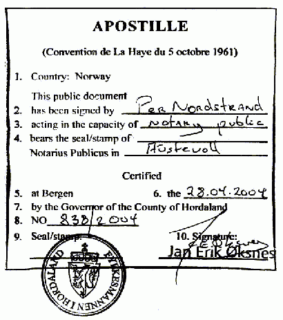
A Norwegian Apostille. Smaller and less ostentatious, but it does essentially the same thing as they do here in 'Murica.
A Norwegian Apostille.  Smaller and less ostentatious than ours, but it does essentially the same thing as they do here in ‘Murica.

An interesting conundrum popped up on my state bar’s listserv recently.  It seems that an attorney tried to have a Durable Power of Attorney notarized at her bank, and the bank said she had to do it at the local courthouse because only the county clerk had the authority to determine the validity of a DPOA.  She was justifiably bemused– since when does a notary have the right, or even responsibility, to determine the validity of a document?

In common law systems, at least, a notary’s job is not to attest to the facts or assertions or statements or anything else contained in a document.  Their job is to point to a fellow’s signature and say “yep, I watched this guy sign the document and he showed me his ID that said his name is Bob Fibber, and –> that’s Bob Fibber’s signature.”

End of analysis.  Notaries are not brought in to give a document’s contents any legal weight.  They’re brought in to attest to a signature’s validity.*

My colleagues on the listserv offered that it may be the bank’s policy to not notarize documents drawn up by lawyers (which pretty much eliminates half of the documents they notarize, I’d wager), but the fact they even think they can critique the document is a bit disconcerting.  In short, what’s the point of offering notary services to your depositors if you’re going to tell them what they can and cannot sign?  This is dangerously close to the unauthorized practice of law.

One colleague expressed frustration with having to repeatedly educate bank officers.  One.  Officer.  At. A. Time.

But the misconception even affects lawyers, especially when an Apostille is involved.  To clear up the misconception, an Apostille does no more than a notarization does.  It points to a notary’s signature and says “yep, Sally Clark is a notary designated by the proper authority in this jurisdiction, and –> that’s Sally Clark’s signature, so her notarization has legal effect in other Hague Apostille Convention countries.”  **

Occasionally, a debate arises in which someone says “um, you can’t Apostille a contract, because a contract isn’t a public document.”  To be sure, the name of the treaty is the Convention of 5 October 1961 Abolishing the Requirement of Legalisation for Foreign Public Documents.  (Emphasis mine.)

True– a contract is usually not a public document.  But the notarization is.  (Thus the term notary public.)  And that is, again, what the Apostille refers to.  Not the contents of the document, not even the validity of the signature thereon, but the validity of the notarization.

Could someone help me down?  This soapbox is quite tall.


* Of course, the signature of a public official on a public document is different, but that’s not the issue here.  The issue pertains to a notary, not a government clerk.

** Bob Fibber and Sally Clark are entirely made up names.  There may very well be a real Bob Fibber (what an unfortunate name) and I’m certain there are many real Sally Clarks.  I don’t know them, and the use of their names herein must not be construed as… aw, to heck with the legalese.  You get the point.

Yes, counsel, you do have to translate that thing—at least, if you’re sending it to a non-English-speaking country.  There are a couple that don’t require translation, but that doesn’t mean it isn’t still necessary.  [Click here to see why.]

That said, getting a translation is not as simple as a Google search to find a guy who speaks Chinese.  Why?  A whole bunch of reasons—all of them potentially fatal to your ultimate goal, which is a check that your client can cash.  Always, always, always, address these issues with your translator, and if s/he doesn’t know what you’re talking about, find a different translator.

We discuss these issues in a two-part series.  Part 1 is here, and details localization and some peculiar differences among languages with the same name.

FORMATTING

Every page, every word, every claim that is handed to the defendant should be formatted to look like the original (the “source document”).  Some examples:

  • The text on page 12 of the complaint should be reflected entirely on page 12 of the translation.
  • If the summons bears a stamp from the 324th Circuit Court for the Middle District of Galveston, and that stamp includes the English phrase “Don’t Mess With Texas” in the upper right hand corner, then your translator should include a reference to the stamp and translate “Don’t Mess With Texas” into the target language, situated in the upper right hand corner.*
  • If handwritten script in an exhibit (yes, those have to be translated as well) is illegible, even in English, then the translator just needs to indicate that the particular text is illegible.  Foreign judges are smart.  They get it.  But if the translator doesn’t address the issue, those foreign judges may rightly assume the questionable text is problematic, rather than illegible.

PRICING

Ten bucks a page is not a deal.  It is a guarantee that the translator is clueless, about either the linguistics or about running his business.  In either case, you could be headed for disaster if you just take the low bid without considering the totality of circumstances.

Most translators price by the word.  If they price by the page, then somebody is losing out– either you’re paying far more than you should, or they’re underbidding the project in a vacuum– in which case see my comment above about cluelessness.

Handy tip: if you send them documents in Word (the Microsoft format), odds are they’ll give you a lower rate per word, because it makes their life a whole bunch easier.

TWELVE VARIATIONS ON A WORD

SNOWThe native tribes of Alaska and northern Canada, if you believe the urban myth, have a hundred words for snow, and each one of them refers to a different type of snow on the dry-wet scale (X-axis) and the light-heavy scale (Y-axis).

But let’s say your complaint deals with a defendant’s use of a patented chemical in paint.  It makes for vivid blues and greens and reds and yellows… but how do you translate the shades of blue?

Azure.  Sapphire.  Turquoise.  Powder blue, baby blue, sky blue, Royal Blue (that would point to the 2015 World Series Champions, thank you), navy blue, midnight blue…

In short, context is key, so don’t be surprised if your translator calls you for clarification on a word that could go six different ways when it morphs into French.

WRAPPING UP

Above all, don’t mess around with this subject, and don’t cheap out on it.  Just don’t.  This is the easiest variable in all of litigation to disaster-proof, and it’s the hardest to explain away when your client asks why he just lost his case.  Hire a reputable company with a track record (or at least a webpage, for crying out loud!), preferably one that hires linguists with the appropriate vocabulary expertise (legal, scientific/engineering, medical, cultural).  Don’t assign the job to Timmy the Mailroom Intern because he spent a semester in Paris, and for crying out loud, DON’T USE GOOGLE TRANSLATE.

Just because you can get a low-cost translation doesn’t mean you should.


Roy Perez, Pitmaster at Kreuz Market

* In Part 1, I mentioned that Texas Barbecue eschews pork, and that fact makes it automatically inferior to all other forms.  I now stand corrected, because the legendary Kreuz Market has brought swine to Lockhart. The word magnificent doesn’t begin to describe it.